Why Packaging Matters in Cross-Border Print Projects When you order custom printed books from overseas, packaging is one of the most critical factors determining whether your products arrive in perfect condition. Even if the printing quality is flawless and the binding is precise, weak or inadequate packaging can undo all that work during the long journey across borders and climates. From the factory floor to the final delivery address, printed goods face a gauntlet of handling, stacking, moisture, and temperature changes. The strength and design of the packaging is what stands between your books and damage.
Many buyers focus heavily on print quality, paper stock, and binding styles — and rightly so — but underestimate the role that proper packaging plays in the overall success of their order. A book that looks stunning in the factory but arrives dented, damp, or with crushed corners creates a poor unboxing experience and can damage your brand reputation. That is why the production team pays meticulous attention to every step of the packaging process, treating it with the same care as the printing itself.
Packaging Materials We Use Before diving into the specific workflows for sea and air shipping, it helps to understand the core materials that protect your printed products throughout their journey. Each material serves a distinct purpose, and together they form a comprehensive protective system.
Waterproof Bag — Also known as a moisture barrier bag, this is the first line of defense against water and humidity. Condensation and moisture are common during ocean freight, especially when containers pass through tropical climates or experience temperature swings. The waterproof bag keeps the contents completely dry even in these challenging conditions.
5AA Carton — The 5AA grade carton is one of the strongest corrugated boxes available for commercial shipping. It is engineered to withstand significant pressure and impact, making it ideal for heavy book shipments. The double-wall or triple-wall construction of a 5AA carton protects against crushing during container stacking and transit handling.
Plastic Belt / Strapping Tape — Also referred to as strapping tape, this material is used to bind cartons together and secure them to shipping pallets. It holds boxes firmly in place during transit, preventing them from shifting or sliding, which is one of the most common causes of package damage.
Packaging Paper — Protective packaging paper is placed inside the carton and around the books to cushion edges and fill voids. It prevents books from moving freely inside the box and absorbs minor impacts during handling. This is especially important for high-value or delicate items such as hardcover books with foil-stamped covers.
Corner Protectors — These are rigid strips placed over the corners of each carton. During loading and unloading, boxes are often bumped, dropped, or squeezed by forklifts. Corner protectors reinforce the most vulnerable points of the carton and significantly reduce the risk of corner crushing or tearing.
Stretch Film / Plastic Film — Also called stretch wrap, this is a highly elastic plastic film that is wrapped around entire pallets of goods. It holds all cartons tightly together as a single unit and provides a barrier against dust, moisture, and light rain. Stretch film is essential for sea freight, where containers can be exposed to humidity and condensation over weeks or months.
Sea Shipping Packaging Process Sea freight is the most common shipping method for large-volume print orders due to its cost-effectiveness over long distances. However, ocean voyages are also the most demanding on packaging because goods spend extended time in a container, often exposed to humidity, salt air, and rough handling at multiple transfer points. The following process is applied to all sea freight orders to maximize protection.
Step 1 — Individual Carton Preparation — Each hardcover or perfect-bound book order is carefully placed inside a 5AA carton lined with a waterproof bag. The books are positioned to minimize movement inside the box, and protective packaging paper is used to fill any gaps and cushion the edges. For paperback or lighter stock, the approach is adjusted to use appropriately sized cartons to prevent empty space and shifting.
Step 2 — Carton Sealing — Once the books are securely inside the carton, the side flaps are folded down neatly and the carton is sealed using an automatic carton sealer machine. This machine applies uniform pressure across the seals, ensuring a consistent and secure closure on every box. The automated process also eliminates human error and ensures repeatability across hundreds of cartons.
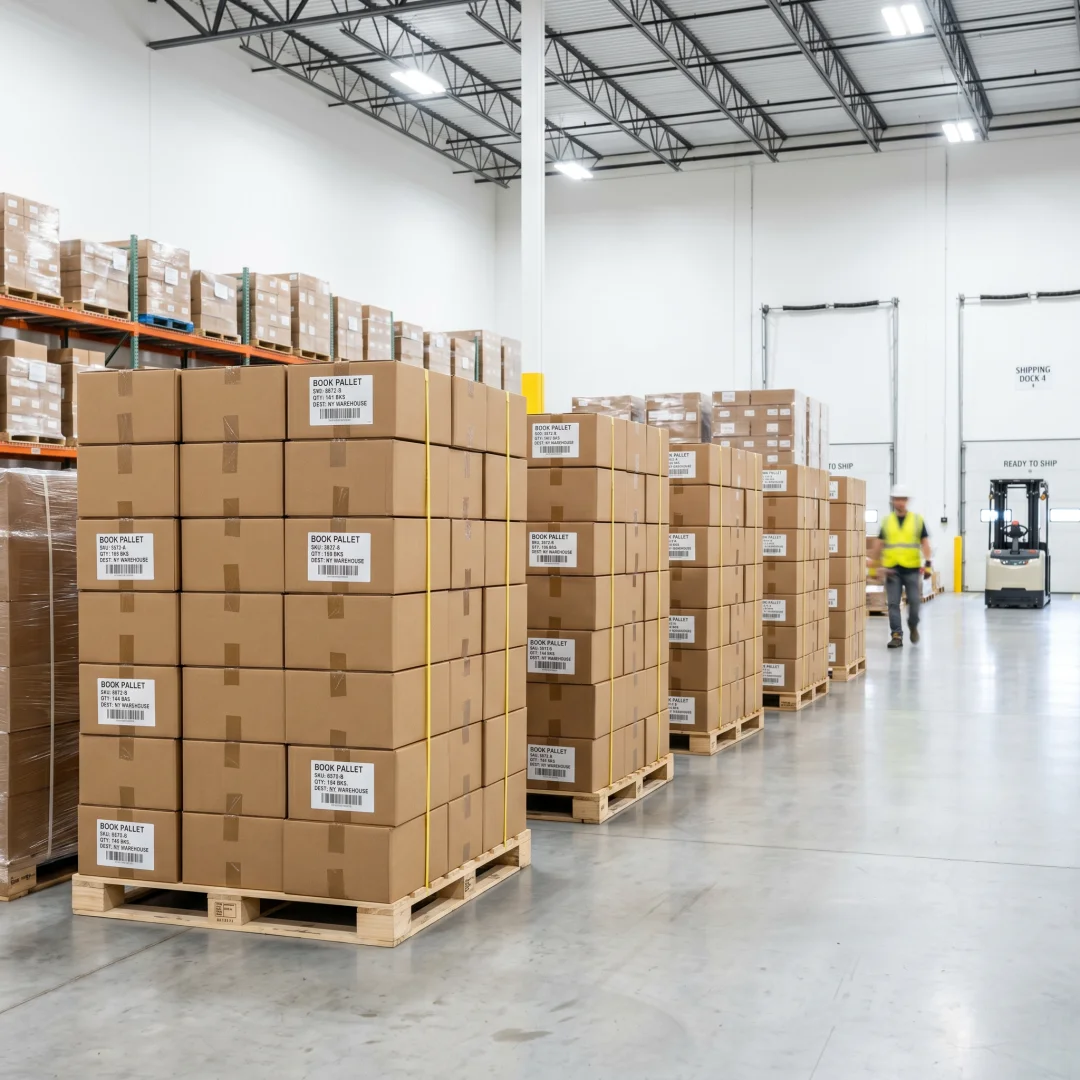
Step 3 — Palletizing and Securing — For orders large enough to justify full palletization, the sealed cartons are arranged on a wooden shipping pallet in a stable configuration. Each layer of cartons is strapped together using plastic strapping tape before the next layer is stacked. Once the full pallet is assembled, additional straps are wrapped around the entire palletized stack to bind all cartons into a single, rigid unit.
Step 4 — Corner Protection — Corner protectors are installed on all four bottom corners of the pallet and on the exposed vertical corners of the stacked cartons. These protectors are typically made from rigid cardboard or plastic and absorb the impact from forklift tines and crane hooks during loading and unloading operations at ports.
Step 5 — Stretch Film Wrapping — The entire pallet, including all cartons and corner protectors, is wrapped in multiple layers of stretch film. The film starts from the base of the pallet and winds upward, overlapping each layer by about fifty percent to create a continuous moisture barrier. This final wrapping step is what keeps humidity, rain, and seawater spray from reaching the cartons during ocean transport.
Key Principle for Large Orders — When an order is large enough to fill one or more complete pallets, the factory applies protective measures to the entire pallet as a single unit rather than treating each carton individually. This pallet-level protection is more effective because it distributes impact forces across the whole load and reduces the risk of individual boxes being exposed during handling.
Air Shipping Packaging Process Air freight is the preferred choice for smaller orders or situations where speed is critical. While air cargo is generally handled more carefully and travels faster than sea freight, the packaging still needs to provide solid protection because cargo is transferred between aircraft, trucks, and warehouses multiple times during the journey.
Step 1 — Waterproof Bag and Double-Layer Carton — Each book or book set is first sealed inside a waterproof bag to guard against moisture and humidity. The bagged items are then placed into a thick carton — for air shipments, the factory uses two layers of carton or a double-wall construction for added impact resistance. This double-layer approach provides superior cushioning compared to single-wall cartons.
Step 2 — Sealing and Reinforcement — The carton flaps are folded precisely and sealed along all edges with high-strength packaging tape. The additional reinforcement ensures that even if the outer carton is damaged during handling, the inner layer continues to protect the books. The tape used for air freight sealing is wider and thicker than standard tape to withstand more demanding handling conditions.
When to Choose Air Shipping — Air freight is most suitable for sample orders, urgent reprints, smaller quantities that do not require a full pallet, or shipments to countries where sea freight transit times are prohibitively long. While air freight costs more per kilogram, the reduced transit time and lower risk of humidity damage can make it a cost-effective choice for time-sensitive projects.
Our Core Packaging Principles Regardless of whether a shipment goes by sea or air, the factory follows a consistent set of packaging principles designed to ensure that every customer receives their books in the same condition they left the production floor.
Principle 1 — Large Orders Are Palletized for Full Protection — For bulk orders that qualify for pallet shipping, the team applies protective measures to the entire pallet rather than focusing on individual cartons. This approach means the whole unit is wrapped, strapped, and corner-protected as one, making it far more resistant to the rigors of long-distance freight forwarding. The result is fewer touch points where damage can occur and a more predictable receiving experience.
Principle 2 — Small Orders Receive Individual Carton Protection — For smaller orders that cannot fill a full pallet, the team applies concentrated protection to each individual carton. This means using the appropriate carton grade for the weight and size of the books, filling all voids with protective paper, sealing all seams thoroughly, and adding corner protectors to guard against impacts during loading and unloading.
Principle 3 — Every Decision Serves the End Customer — The underlying goal of this rigorous packaging process is simple: to ensure that your customers receive their books in perfect condition, which leads to positive reviews, repeat orders, and a strong reputation for reliability. When a book arrives damaged, the cost of returns and reprints far exceeds the investment in proper packaging. Strong packaging is therefore not an expense — it is an investment in customer satisfaction and long-term business relationships.
Get in Touch With Your Questions If you have any questions about how your specific order will be packaged, or if you have special requirements such as branded packaging materials, custom box sizes, or additional protective measures for high-value editions, please do not hesitate to reach out. The production team is happy to walk you through the packaging options and recommend the best approach for your particular project needs. Contact us today to learn more about how we protect your printed products from the factory floor to your customer’s doorstep.