Understanding Book Printing Lead Times: A Complete Guide When you commission a print project, one of the most common questions asked upfront is: “How long will it take?” In the printing industry, this duration is referred to as the Lead Time or Production Turnaround Time — the period from the moment an order is confirmed to the point when the finished product is ready for shipment. Understanding this timeline is essential for planning your launch schedule, marketing campaign, or event rollout.
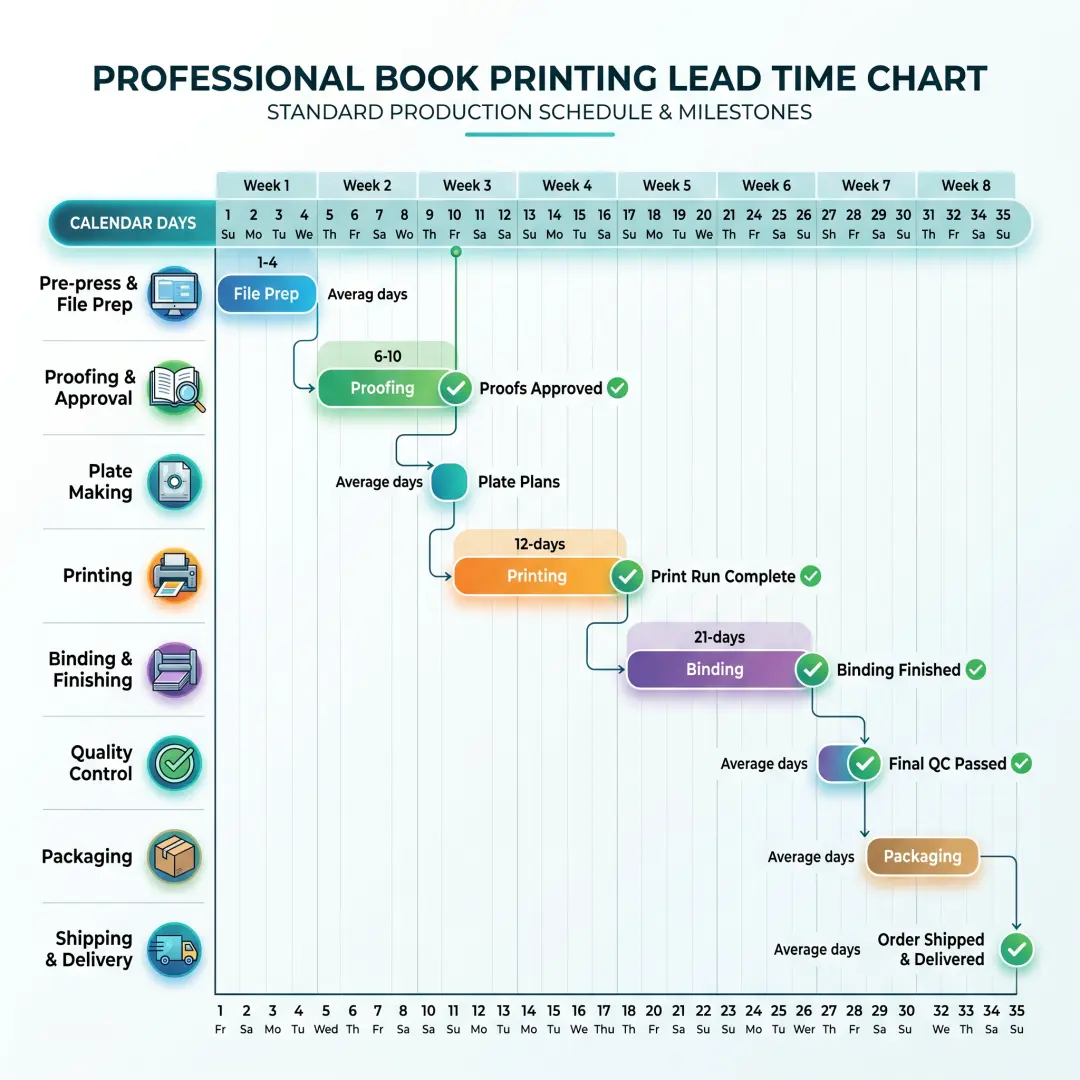
A typical production turnaround encompasses several stages: printing , cutting , binding , surface finishing , quality inspection , and packaging . Each of these steps requires a specific amount of time, and the total duration can vary significantly depending on the complexity of your project. For most book printing orders, lead times can range from as few as 7 days to as many as 20 days , influenced primarily by order quantity, binding method, paper specifications, and any special finishing requirements such as foil stamping, spot UV, or embossing.
This guide walks you through everything you need to know about production timelines — from standard lead times for popular product categories to the conditions that determine when your countdown officially begins.
Standard Production Lead Times by Product Type Different print products carry different production timelines. The complexity of the binding method, the number of components, and the finishing processes involved all play a role in determining how long your order will take. Below is a general reference guide based on typical production schedules.
It is important to note that these timeframes are estimates based on standard order quantities and standard specifications. Orders with elevated quantities, non-standard sizes, or premium finishing options may require additional production days.
Book Printing Saddle Stitch Books — Saddle stitching is one of the fastest binding methods available. Because the pages are stapled along the spine in a single pass, the production process is relatively straightforward. Expect a lead time of approximately 10 to 12 days for most quantities.
Paperback / Softcover Books — Perfect binding involves gluing individual pages to a softcover spine. This process requires more handling than saddle stitching, including trimming and glue application. Lead times generally fall between 12 and 15 days .
Hardcover Books — Hardcover production is the most involved of the standard book formats. The process includes case making, fabric covering, spine lining, and attaching the boards to the text block. These additional steps extend the production timeline to approximately 15 to 18 days .
Spiral and Wire-O Bound Books — These binding styles involve punching holes along one edge and threading a metal or plastic coil through them. While the binding process itself is relatively quick, the punching and collating steps add time. Most orders are completed within 15 to 18 days .
Board Books — Board books are constructed from heavy paperboard pages that are laminated, cut, and bound together. The lamination and board mounting process is labor-intensive, typically resulting in a lead time of 15 to 18 days .
Other Printed Products Cards and Card Decks — Playing cards, tarot decks, and custom card sets require printing, cutting, and often lamination or varnish coating. Standard production takes approximately 10 to 15 days , depending on quantity and finishing options.
Paper Boxes and Bags — Custom packaging such as book slipcases, product boxes, and paper bags involve die-cutting, folding, and often adhesive or stitch bonding. Production typically requires 15 to 18 days .
Labels and Stickers — Among the fastest turnaround products, labels and stickers involve simpler production workflows with minimal binding requirements. Most orders are fulfilled within 7 to 9 days .
Calendars — Wall calendars and desk calendars require binding, hole punching for hanging, and often the attachment of calendar grids or easel backs. Production generally takes around 18 days , though this can vary based on format and finishing.
The above timelines are intended as a general guide. Final lead times are confirmed at the time of order confirmation, taking into account your specific quantity, chosen specifications, and the current production schedule.
When Does the Lead Time Start? One of the most frequent sources of confusion for first-time print buyers is determining the exact moment when the production countdown begins. Lead time does not start from the moment you submit an inquiry or even from the moment you place an order. A number of conditions must be satisfied before the factory can begin production.
A 50% deposit has been paid. — Production does not begin until payment terms are agreed upon and at least 50% of the total order value has been received. This is standard practice in commercial printing and protects both parties.
The digital proof has been approved. — Before any printing press runs a single sheet, the pre-press proof must be reviewed and formally approved by the customer. This proof represents the exact layout, colors, and content that will appear in the final product. If corrections are needed, the proof must be revised and re-approved before production proceeds.
Print-ready artwork has been provided. — All artwork files must meet the factory’s print-ready specifications. This includes correct color profiles, bleed settings, image resolution, and proper margins. Files that do not conform to these standards may be rejected or require modification, which can delay the start of production.
Any file errors have been corrected and mutually confirmed. — If the pre-press team identifies any issues with the submitted files — such as missing fonts, low-resolution images, or bleeds that fall short of requirements — these must be resolved and re-confirmed by both parties before production begins. This step is critical and should never be rushed, as errors caught during production are far more costly to correct than those caught during the proofing stage.
Once all of the above conditions have been met, your order enters the production queue and the agreed lead time officially begins.
Can You Rush an Order? Sometimes a project has a hard deadline that falls outside of the standard production window. Whether it is a trade show, product launch, or seasonal promotion, tight deadlines do happen. The good news is that many printing facilities are able to accommodate rush production under the right circumstances.
Communicate your timeline early. — If you have a critical deadline, it is essential to inform your account manager or sales representative as soon as possible — ideally at the time of the initial quote request. This gives the production team the maximum amount of time to explore options. The later you mention a rush requirement, the fewer options may be available.
Expedited production may be possible. — In many cases, the factory can arrange extended operating hours to meet a tighter schedule. This may involve running production shifts around the clock, prioritizing your job in the queue, or adjusting scheduling to fast-track your order. Rush fees may apply depending on the degree of acceleration required.
Shipping solutions for tight deadlines. — Even if the production timeline cannot be compressed further, there are often shipping alternatives that can help meet your deadline. For example, if sea freight will not arrive in time, a partial air freight shipment can be arranged to get a portion of your order to the destination faster, with the balance following by sea. This hybrid approach can significantly reduce the delivery gap in time-sensitive situations.
Not every order can be expedited, and the feasibility of rush production depends on current shop load, material availability, and the specific requirements of your project. Early and transparent communication is always the best strategy.
Factors That Can Extend Lead Time While the standard timelines listed above cover most orders, certain conditions can extend the production window beyond the typical range. Being aware of these factors helps you plan more accurately and avoid surprises.
Order Quantity. — Larger quantities typically require longer press runs and more time for finishing and packaging. A run of 5,000 books will generally take longer than a run of 500, even if the binding method is the same.
Special Finishing Processes. — Premium finishes such as foil stamping, spot UV coating, embossing, or debossing require additional setup time and pass-through steps that are not part of standard production. Each added process extends the overall timeline.
Non-Standard Sizes and Formats. — Custom dimensions may require new die cuts, specialized jigs, or adjusted press settings, all of which add time to the pre-production phase.
Seasonal Demand Fluctuations. — During peak periods — such as the months leading up to the holiday season or around major trade shows — production facilities often experience higher order volumes. Booking early is strongly recommended during these periods to secure your preferred timeline.
Complex Artwork or Multiple Versions. — If your project involves multiple versions (such as different covers for the same interior), personalized content, or complex multi-page layouts, additional proofing and production time should be anticipated.
Plan Ahead for the Best Results Understanding lead times is one of the most practical skills a print buyer can develop. By accounting for production timelines at the earliest stages of your project planning, you give yourself the flexibility to choose the right binding method, the appropriate finishing options, and the most cost-effective shipping method — without being forced into a rush-order premium.
If you have questions about lead times for a specific project, or if you would like to receive a detailed production quote tailored to your requirements, the best step is to reach out directly. Provide as much detail as possible about your product type, quantity, specifications, and desired delivery date, and the team will give you an accurate assessment of what is achievable.
Get a Custom Quote for Your Project Every print project is unique, and the most reliable way to get an accurate lead time and price is to request a formal quote. Share your project details — including product type, quantity, size, paper selection, binding preference, finishing requirements, and target delivery date — and you will receive a comprehensive proposal that covers both production timelines and costs.
Whether you are producing your first book run or managing an ongoing series of print campaigns, having a clear picture of the production schedule helps keep your project on track from concept to delivery.